BATTERY ENERGY STORAGE · 2026-11-25
What is BESS? A Complete Guide to Battery Energy Storage Systems
What is BESS, and why is it essential for the future of clean energy? Explore how Battery Energy Storage Systems store electricity, optimise energy consumption, enhance solar energy utilisation and transform residential, commercial, industrial and utility-scale power infrastructure.
Storing Energy Today. Powering Tomorrow.
As the world transitions towards renewable energy and sustainable infrastructure, the ability to store electricity efficiently is becoming increasingly important. While solar and wind energy offer cleaner alternatives to conventional power generation, their availability varies throughout the day.
This is where Battery Energy Storage Systems (BESS) play a transformative role.
From residential buildings and commercial establishments to large industries and utility-scale renewable energy projects, BESS is changing how electricity is generated, stored, managed and consumed.
1. What is BESS?
BESS stands for Battery Energy Storage System. It is an advanced technology that stores electrical energy in rechargeable batteries and releases it whenever required.
A BESS can store electricity generated from solar panels, wind turbines or the electrical grid. The stored energy can subsequently be used during peak demand periods, power interruptions or when renewable energy generation is unavailable.
Unlike conventional battery backup systems, modern BESS solutions integrate intelligent energy management, power conversion, real-time monitoring and automated control technologies.
2. How Does a Battery Energy Storage System Work?
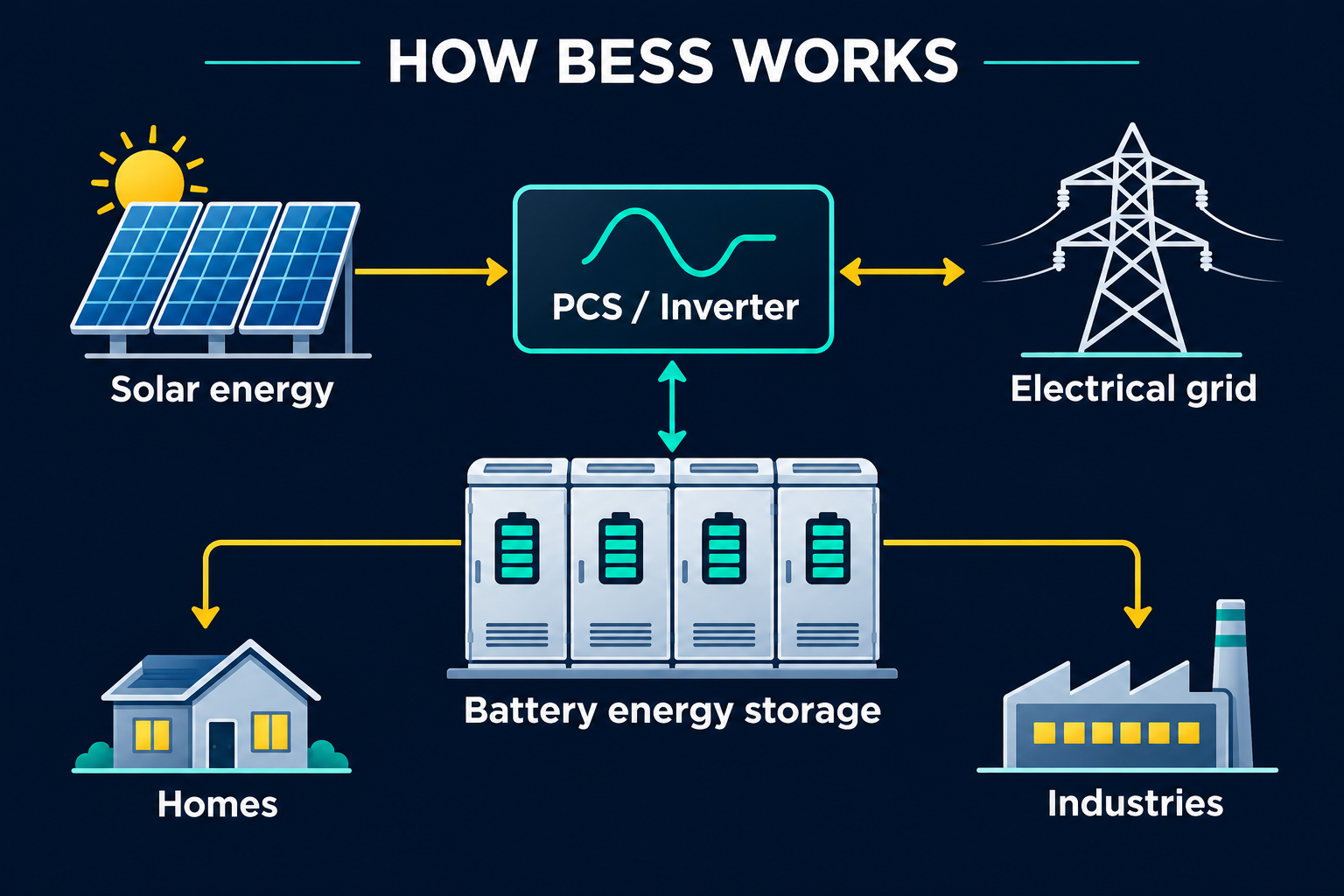
A Battery Energy Storage System operates through four fundamental stages:
- Energy Generation: Electricity is generated from renewable energy sources or supplied by the electrical grid.
- Energy Storage: Electrical energy is stored in rechargeable battery modules.
- Intelligent Energy Management: An Energy Management System monitors energy generation, consumption, battery capacity and operating conditions.
- Energy Discharge: Stored electricity is released whenever required, based on programmed operating strategies.
For example, a solar-powered building can store excess electricity generated during the daytime and utilise it during the evening, reducing its dependence on grid electricity.
3. Key Components of a BESS
A modern Battery Energy Storage System consists of several interconnected technologies.
| Component | Function |
|---|---|
| Battery Cells and Modules | Store electrical energy |
| Battery Management System (BMS) | Monitors battery health, voltage, temperature and safety |
| Power Conversion System (PCS) | Converts electricity between AC and DC |
| Energy Management System (EMS) | Optimises energy storage and consumption |
| Thermal Management System | Maintains suitable operating temperatures |
| Fire Detection and Protection | Helps identify and mitigate fire-related risks |
| Electrical Protection System | Provides electrical protection and safe isolation |
| Remote Monitoring System | Enables real-time performance monitoring and diagnostics |
These components work together to ensure efficient, reliable and safe energy storage operations.
4. Types of Battery Technologies Used in BESS
Different battery technologies are available depending on the application, operating environment and energy storage requirements.
- Lithium Iron Phosphate (LFP): Widely adopted in stationary energy storage due to its thermal stability and long cycle life.
- Lithium Nickel Manganese Cobalt (NMC): Offers high energy density and is suitable for applications where space and weight are important.
- Sodium-ion Batteries: An emerging alternative with potential advantages in material availability and cost.
- Flow Batteries: Suitable for certain large-scale and long-duration energy storage applications.
- Lead-acid Batteries: A conventional technology commonly used in traditional backup power systems.
Lithium Iron Phosphate technology is increasingly preferred for many modern stationary energy storage applications.
5. Understanding kW, kWh, MW and MWh
Battery Energy Storage Systems are generally specified using two important parameters: power and energy capacity.
Power Capacity (kW or MW) determines how much electrical power the system can deliver at a given moment.
Energy Capacity (kWh or MWh) determines how much electrical energy the system can store.
For example, a 100 kW / 200 kWh BESS can theoretically deliver 100 kW of power for approximately two hours.
Actual discharge duration depends on usable battery capacity, system efficiency, operating conditions and discharge limitations.
Understanding these parameters is essential when selecting the right energy storage system.
6. Applications of Battery Energy Storage Systems
Residential Energy Storage
Homeowners can combine rooftop solar systems with battery storage to utilise solar energy during the evening, provide backup power and improve energy independence.
Commercial and Industrial Energy Storage
Commercial buildings, factories, warehouses, hospitals and IT facilities can utilise BESS for peak demand management, energy cost optimisation, renewable energy integration and backup power.
Utility-Scale Energy Storage
Large-scale battery storage systems support electrical grids by balancing renewable energy generation, managing peak demand, providing frequency regulation and improving grid stability.
Electric Vehicle Charging Infrastructure
BESS can support EV charging stations by managing high charging loads, reducing peak grid demand and integrating renewable energy sources.
Microgrids and Remote Locations
Battery storage enables microgrids, remote facilities and isolated communities to manage renewable energy more effectively and reduce dependence on conventional diesel-based generation.
7. Benefits of Battery Energy Storage Systems
Reduced Electricity Costs
BESS can help reduce electricity expenses by storing energy during lower-cost periods and discharging it during higher-cost periods, subject to applicable electricity tariffs.
Peak Demand Management
Industrial and commercial consumers can use stored energy during peak load conditions to potentially reduce maximum demand charges.
Increased Solar Energy Utilisation
Excess solar energy generated during the daytime can be stored and utilised when solar generation is unavailable.
Improved Power Reliability
Suitably designed BESS installations can provide backup power during grid interruptions and support critical electrical loads.
Reduced Diesel Dependency
Battery storage can reduce diesel generator operating hours in suitable applications, helping lower fuel consumption, noise and local emissions.
Energy Independence
Combining renewable energy with battery storage allows consumers to gain greater control over their electricity generation and consumption.
Environmental Sustainability
By supporting renewable energy integration and reducing dependence on fossil fuel-based electricity, BESS can contribute to a cleaner and more sustainable energy ecosystem.
8. Solar With BESS vs. Solar Without BESS
| Feature | Conventional On-grid Solar | Solar + BESS |
|---|---|---|
| Daytime solar utilisation | Yes | Yes |
| Stored solar energy at night | No | Yes |
| Backup during grid failure | Generally unavailable | Available with suitable design |
| Peak demand management | Limited | Enhanced |
| Energy storage | No | Yes |
| Energy independence | Partial | Higher potential |
| Initial investment | Lower | Higher |
While conventional solar systems provide significant benefits, integrating battery storage introduces greater flexibility in how and when electricity is consumed.
9. Is BESS the Same as a UPS?
Although both systems can store energy and provide backup power, their primary applications are different.
A conventional Uninterruptible Power Supply (UPS) is primarily designed to maintain uninterrupted power to critical equipment during electrical disturbances or power failures.
A BESS is designed for broader energy management applications, including renewable energy storage, peak shaving, load shifting, grid support and backup power.
Certain BESS configurations can also provide UPS-like functionality when specifically engineered for the required transfer time and power quality.
10. Is Battery Energy Storage Safe?
Modern Battery Energy Storage Systems incorporate multiple layers of monitoring, protection and safety technologies.
These include battery management systems, thermal management, electrical protection, fire detection, emergency shutdown mechanisms and intelligent monitoring.
However, battery safety depends on proper system engineering, equipment quality, installation practices, compliance with applicable standards and periodic maintenance.
Selecting the right technology and an experienced engineering partner is essential for long-term operational safety and reliability.
11. The Future of BESS in India
India's growing electricity demand, expanding renewable energy capacity, electric vehicle adoption and industrial development are creating significant opportunities for energy storage technologies.
Battery Energy Storage Systems are expected to play an increasingly important role in:
- Residential solar energy storage
- Commercial and industrial energy optimisation
- Round-the-clock renewable energy supply
- Electric vehicle charging infrastructure
- Utility-scale energy storage
- Smart grids and decentralised power systems
The future of energy is not simply about generating clean electricity. It is about storing, managing and delivering that electricity intelligently.
12. Explora – Exploring the Future of Energy Storage
At Enerzia, we believe that the next phase of the clean energy transition will be driven by the intelligent integration of renewable energy, battery storage and advanced energy management technologies.
Through Explora, our energy storage initiative, we aim to develop and deliver intelligent energy storage solutions addressing residential, commercial, industrial and utility-scale requirements.
Our vision is to enable greater energy independence, improve power reliability and support a sustainable energy future through innovation and engineering excellence.
Conclusion
Battery Energy Storage Systems represent a fundamental shift in the way the world manages electricity.
By combining renewable energy generation with intelligent energy storage, individuals, businesses and industries can move towards a more reliable, efficient and sustainable energy future.
BESS is not just about storing electricity. It is about unlocking the full potential of clean energy.
Generate Smarter. Store Smarter. Power the Future.
Enerzia Group | Enerzia Solar | Explora
Think Smarter. Go Greener.
To explore solar energy and battery energy storage solutions for your home, business or industry, connect with Enerzia.
Website: www.enerzia.com
Email: info@enerzia.com