
NEWS · 2026-11-21
India’s CEA Proposes Mandatory BESS for New Solar & Wind Projects: What It Means for India’s Renewable Energy Future
India’s renewable energy sector is moving toward a storage-backed future. The CEA has proposed new requirements that could make Battery Energy Storage Systems (BESS) an essential part of new ground-mounted solar and onshore wind projects from 2027. Here’s what the proposal could mean for renewable energy developers and India’s power infrastructure.
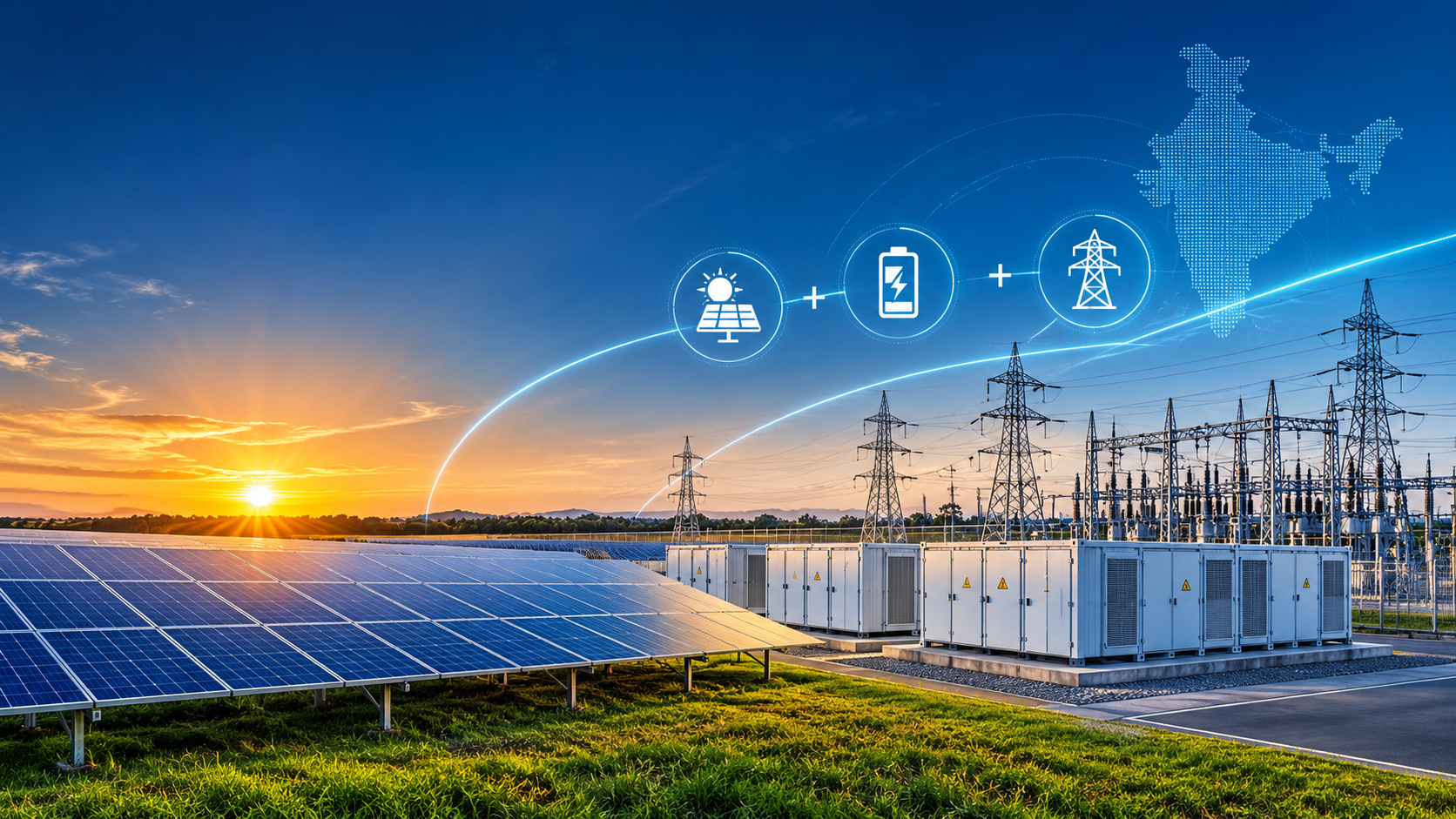
India’s Renewable Energy Future Is Moving Toward Battery Storage
India’s renewable energy sector is entering an important new phase.
Solar and wind power have become major pillars of India’s clean-energy transition. However, as renewable generation continues to grow, the power sector faces an increasingly important challenge: how can renewable electricity be stored and delivered when the grid actually needs it?
Battery Energy Storage Systems (BESS) are emerging as a key part of the answer.
In a significant development, the Central Electricity Authority (CEA) has proposed new technical requirements that could make co-located Energy Storage Systems an integral part of future ground-mounted solar and onshore wind projects.
If implemented in the proposed form, these requirements could influence how renewable-energy projects are planned, designed, engineered and commissioned in India.
What Has the CEA Proposed?
The CEA’s draft Central Electricity Authority (Technical Standards for Construction of Electric Plants and Electric Lines) 2nd Amendment Regulations, 2026 proposes new requirements for renewable-energy projects.
Under the draft, renewable-energy power plants commissioned after 1 July 2027 would need at least 15% of their inverters to have grid-forming control. The draft also proposes that all Power Conversion Systems (PCS) of Battery Energy Storage Systems should have grid-forming control.
More importantly, applicable ground-mounted solar and onshore wind projects commissioned after 1 July 2027 would need to be equipped with a co-located Energy Storage System (ESS).
The proposed requirement is:
- Minimum storage capacity equivalent to 10% of the plant’s installed capacity
- Minimum storage duration of 2 hours
For example, a 100 MW solar power plant would require at least:
10 MW of storage capacity × 2 hours = 20 MWh
The proposal becomes more stringent for applicable projects commissioned after 1 July 2029 and up to 30 June 2031.
For these projects, the proposed requirement increases to:
10 MW × 4 hours = 40 MWh for a 100 MW plant
The CEA draft also states that the Authority may notify changes to the percentage requirements for grid-forming capability or ESS capacity from time to time.
Why Is BESS Becoming Important for Solar Power?
Solar power generation is naturally concentrated during daylight hours.
However, electricity demand does not always follow the same pattern.
During the middle of the day, solar generation can be very high. Later in the evening, solar generation falls while electricity demand can remain high or increase.
This creates a fundamental challenge:
High renewable generation during the day
↓
Energy storage
↓
Power availability when required
BESS can help bridge this gap.
During periods of high renewable generation, batteries can store surplus electricity. When renewable generation decreases or demand increases, the stored energy can be discharged.
This can make renewable power more flexible and dispatchable while helping the grid manage fluctuations in renewable generation.
The Government of India has already identified energy storage as an important requirement for integrating renewable energy. According to the Ministry of Power, the National Electricity Plan projects BESS requirements of 8.68 GW / 34 GWh by 2026-27 and 47.24 GW / 236 GWh by 2031-32.
From Solar Power to Solar + Storage
Traditionally, a utility-scale solar project can be viewed as:
Solar PV → Inverter → Transformer → Grid
The emerging architecture is becoming more integrated:
Solar PV → Inverter → BESS → Grid
This combination allows renewable projects to store electricity and potentially shift energy delivery to periods when it is more valuable or required by the grid.
For project developers, this means energy storage should increasingly be considered during the initial project-design stage rather than being treated as an optional addition at a later stage.
What Is Grid-Forming Technology?
Another important aspect of the CEA proposal is the emphasis on grid-forming capability.
Traditional renewable-energy inverters generally operate in a grid-following mode. They rely on an existing grid voltage and frequency reference.
Grid-forming technology works differently.
Grid-forming inverters can establish and support voltage and frequency characteristics, helping inverter-based resources contribute more actively to grid stability.
This becomes increasingly important as India's electricity system incorporates larger amounts of solar, wind and battery-based generation.
The CEA proposal would require at least 15% of inverters in renewable-energy power plants commissioned after 1 July 2027 to have grid-forming control, while all BESS PCS would need grid-forming control under the proposed provisions.
What Does This Mean for Renewable Energy Developers?
The proposed requirements could have a significant impact on the planning and design of future renewable-energy projects.
1. BESS Planning Will Need to Start Earlier
Storage requirements can influence the complete electrical architecture of a project.
Developers may need to consider:
- BESS capacity
- Storage duration
- Battery technology
- PCS selection
- Transformer capacity
- Switchgear
- Protection systems
- Cable sizing
- SCADA and communication
- Energy Management Systems
- Fire protection
- HVAC and thermal management
- Space requirements
These considerations are better addressed during the initial engineering stage rather than after the main plant has already been designed.
2. Electrical Infrastructure Will Become More Important
The integration of solar generation and BESS creates a more sophisticated electrical system.
The complete system may involve:
Solar PV → Inverters → AC/DC systems → BESS → PCS → Transformer → Switchgear → Grid
Each stage requires appropriate protection, control, isolation and monitoring.
Protection coordination and system studies will become increasingly important as renewable plants combine generation and storage at the same location.
3. Project Costs and Design Strategies May Change
Adding BESS increases the initial capital requirements of a renewable-energy project.
However, storage can also provide operational benefits by allowing energy to be shifted from periods of high renewable generation to periods of higher demand.
Therefore, developers will need to evaluate BESS not simply as an additional cost, but as an important part of the overall project architecture and commercial strategy.
A Growing Opportunity for India's Electrical Industry
The transition toward storage-backed renewable energy is not only an opportunity for solar and wind developers.
It can also create significant opportunities across India's electrical and energy ecosystem.
As BESS deployment increases, demand may grow for:
- Medium-voltage switchgear
- Circuit breakers
- Protection relays
- Transformers
- Cables and accessories
- Power-quality equipment
- Battery Energy Storage Systems
- Power Conversion Systems
- Energy Management Systems
- SCADA and monitoring systems
- Electrical protection and control equipment
- Fire and safety systems
This creates a growing need for companies that understand both renewable-energy applications and electrical-system integration.
India's Energy Storage Journey Has Already Begun
The CEA's latest proposal is not an isolated development.
In February 2025, the CEA issued an advisory on co-locating Energy Storage Systems with solar power projects to improve grid stability and cost efficiency.
That advisory recommended storage equivalent to at least 10% of installed solar capacity for a minimum duration of two hours.
The latest draft proposal takes the discussion further by moving storage requirements into technical construction standards for applicable renewable-energy projects.
This indicates the increasing importance of storage in India's renewable-energy planning.
What Should Businesses Do Now?
Although the CEA requirements discussed here are part of a draft regulatory proposal, renewable-energy developers and electrical-system suppliers should closely monitor these developments.
Companies planning future projects can start preparing by reviewing:
Project Capacity
Understand the potential BESS requirement based on the renewable project's installed capacity.
Storage Duration
Evaluate the impact of 2-hour and future 4-hour storage requirements on project design and economics.
Electrical Architecture
Review how PV generation, BESS, PCS, transformers, switchgear and grid connectivity will work together.
Protection & Control
Evaluate protection relays, circuit breakers, metering, synchronization, control systems and communication requirements.
Safety
Battery storage projects require careful consideration of thermal management, fire detection, emergency isolation and electrical safety.
Future Expansion
Where practical, project infrastructure should consider future storage expansion and changing grid requirements.
The Bigger Picture
India's renewable-energy transition is moving beyond simply adding more generation capacity.
The next phase will increasingly focus on four key elements:
Generation + Storage + Grid Stability + Dispatchability
Solar and wind generation can provide clean electricity.
BESS can provide flexibility.
Advanced inverter technologies can support grid stability.
Together, these technologies can help create a more resilient and flexible renewable-energy system.
Conclusion
The future of renewable energy in India is not only about generating more clean electricity.
It is also about storing, controlling and delivering that electricity when the power system needs it.
The CEA's proposed BESS requirements could accelerate this transformation by making energy storage an increasingly important part of renewable-energy project design.
For developers, EPC contractors and electrical-system suppliers, preparation will be essential.
The renewable-energy projects of tomorrow will increasingly require integrated solutions combining:
Renewable Generation
+
Battery Energy Storage
+
Grid-Forming Technology
+
Electrical Protection & Control
+
Grid Integration
At Enerzia, we believe the future of renewable energy depends not only on producing clean power, but also on building the electrical infrastructure required to safely control, protect, store and reliably deliver that power.
As India moves toward a more storage-integrated renewable-energy ecosystem, early planning and the right electrical engineering approach will be critical to building reliable and future-ready power projects.
Enerzia — Powering the Future of Energy.